Engineering records / Engineering record / PROCESS-PARTITIONS-R1
Process Partitions R1.
Geometry, analysis and remaining engineering work for Process Partitions R1.
Retained development study. Dimensions, names and checks belong to this revision—not automatically to the retrofit-only product. Manufactured tank shells are deferred. No installation instruction, certification or manufacturing release is represented.
The source reasoning
Why this detail was investigated.
Development of the current 2000-gallon vessel with 500 mm access cover. The complete system is not ready for manufacture.
Read the research and limits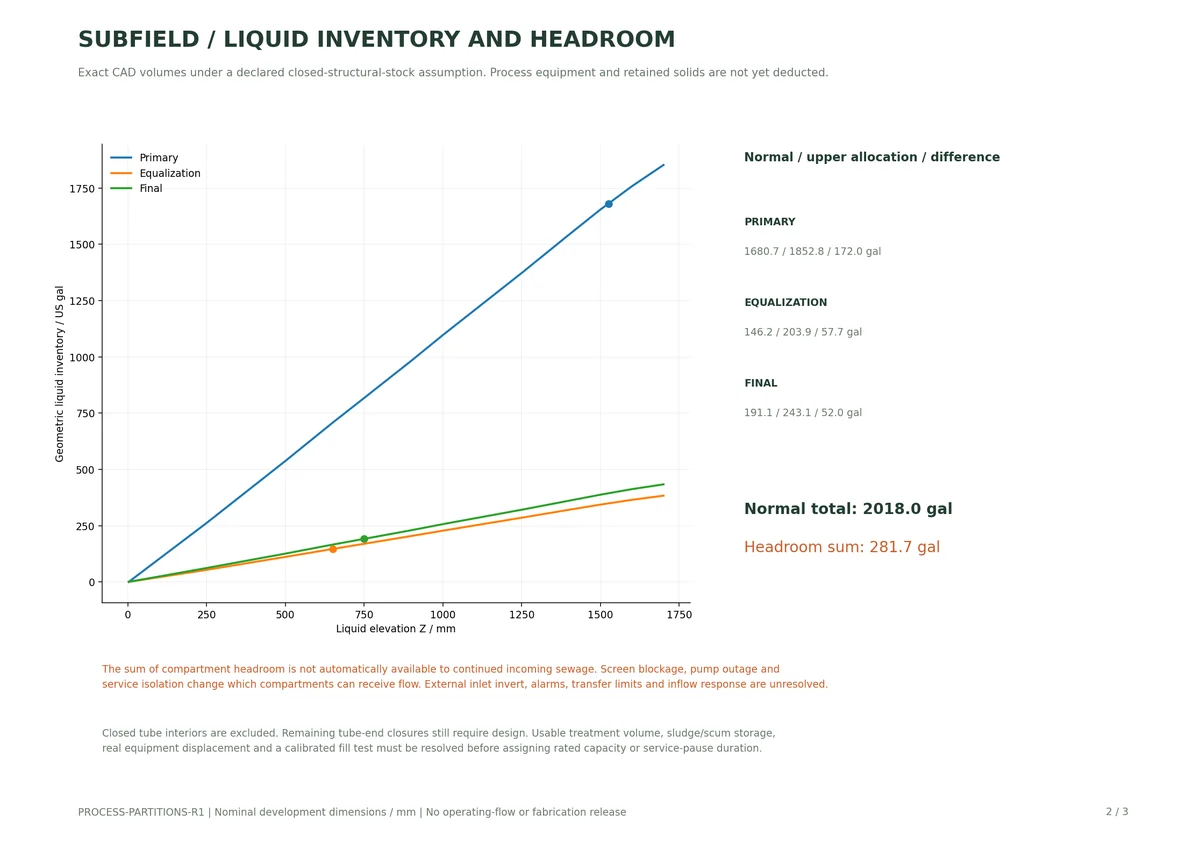
Research record
The detail behind
the study.
Source-linked work for this revision. Reported checks describe the stated model or test; physical qualification and applicability to the current retrofit remain separate.
Development of the current 2000-gallon vessel with 500 mm access cover. The complete system is not ready for manufacture.
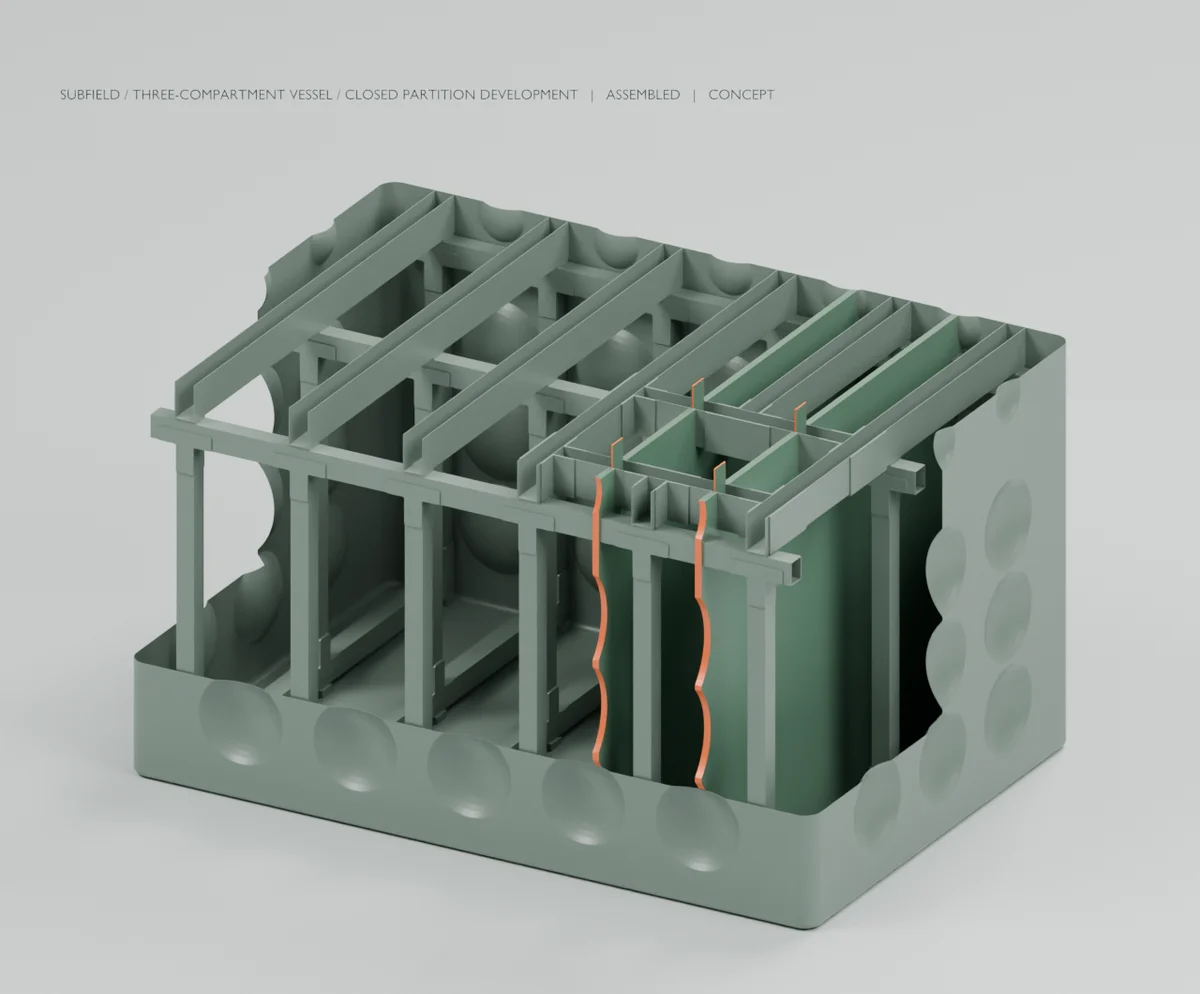
Two closed hydraulic partitions divide primary, equalization and final compartments. This package adds 48 separate solids: composite faces, foam core, solid edge closeouts, face bonds, shell bonds, ten internal structural-stock bulkheads and their bonds. The retained vessel/access assembly now contains 2308 solids. STEP dimensions are millimetres.
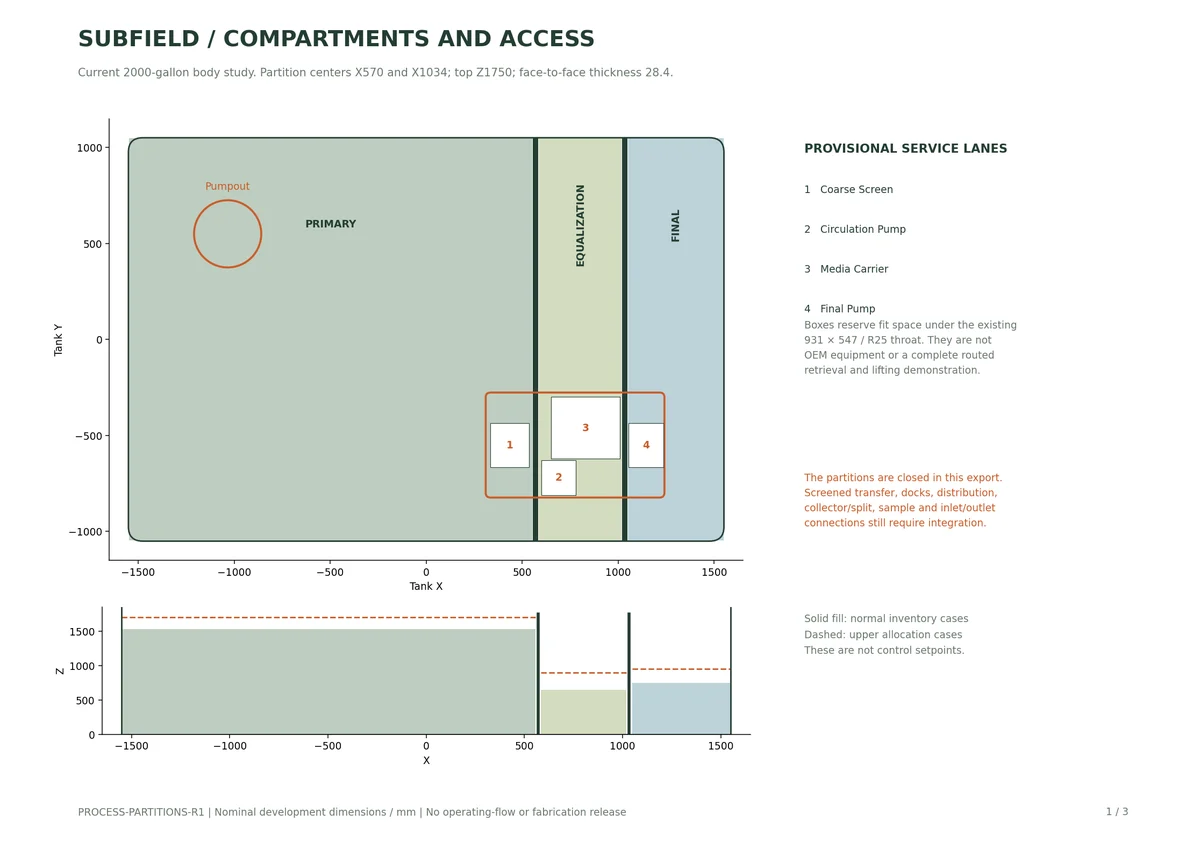
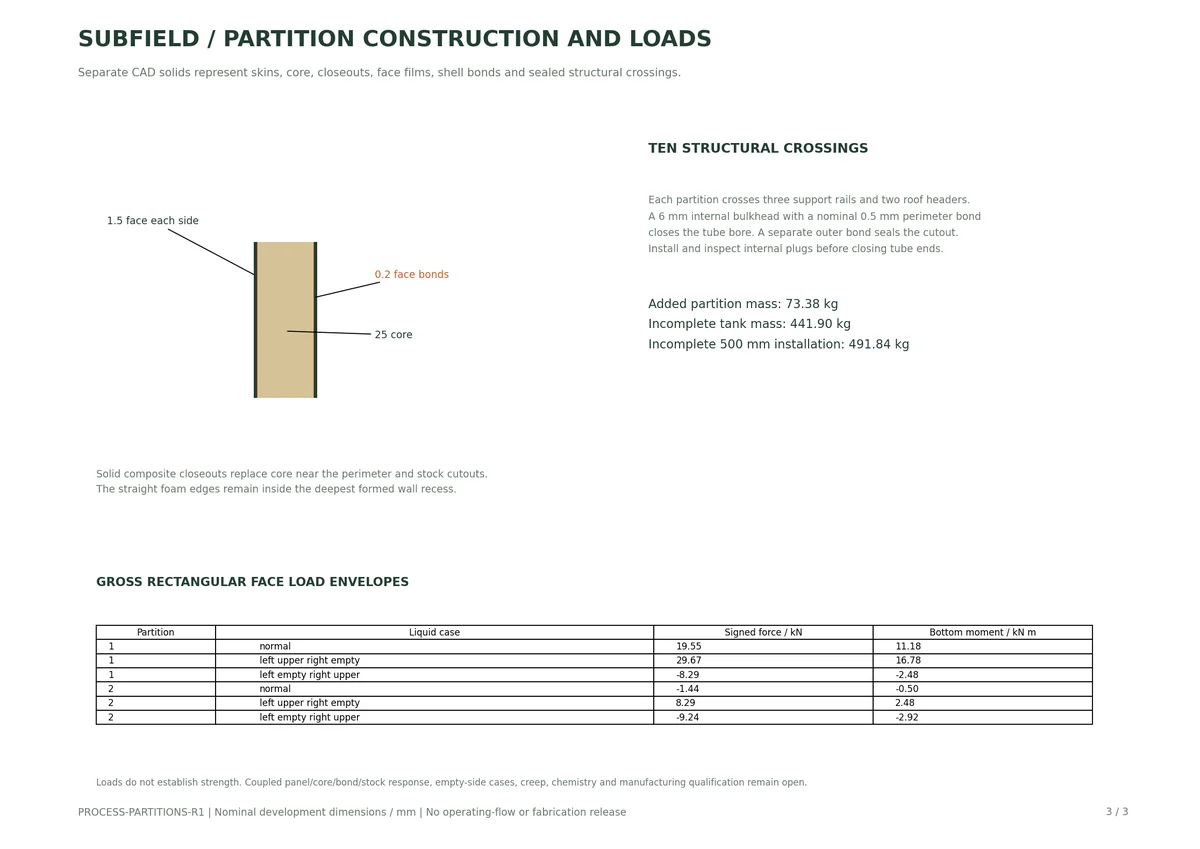
The partitions are at X570 and X1034, with top Z1750 and a 28.4 mm sandwich stack: 1.5 mm face, 0.2 mm face bond, 25 mm core, 0.2 mm face bond and 1.5 mm face. The shell bond allowance is nominally 0.5 mm and follows the analytic formed-wall construction. This is not a released bond tolerance. Straight core blanks stop inward of the deepest wall recesses; solid closeouts follow the remaining contour and structural cutouts.
The modeled partitions are closed. There is no working treatment flow path in this export. Screened transfer, actual pump docks, distribution, underdrain, recycle/final split, samples, external inlet/outlet and process ventilation remain to be connected. This geometry does not authorize an untreated bypass.
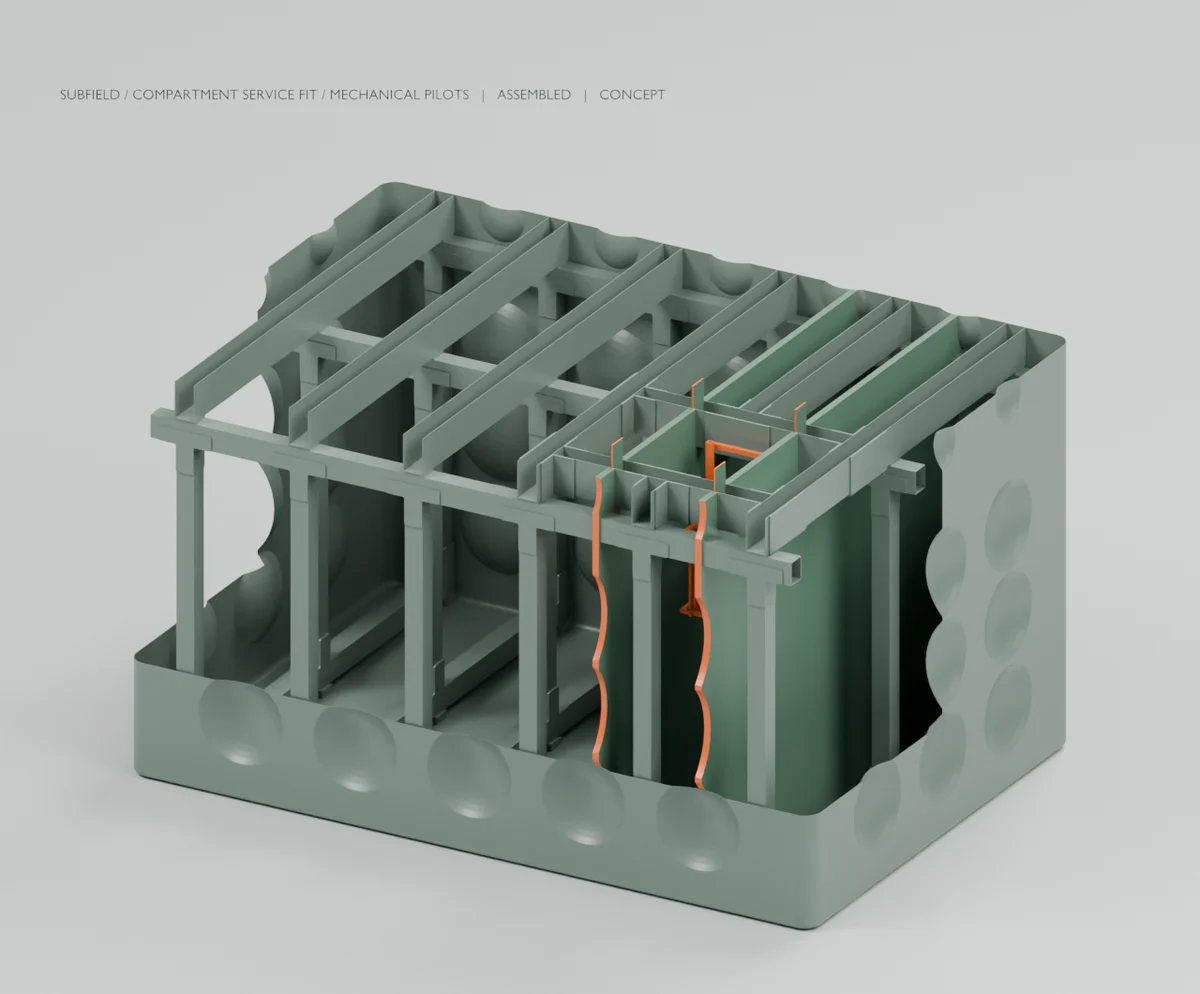
- vessel-with-process-partitions.step: complete current tank, roof, shallow access and partition geometry. - process-partitions.step and the individual partition-...step files: added parts, including internal tube bulkheads. - process-partition-review.pdf: three reference sheets for compartment layout, liquid inventory and construction/load implications. - partition-record.json, partition-part-takeoff.csv: dimensions, contacts/intersections, volumes, loads, mass and source hashes. - normal-liquid-inventory-reference.step, upper-liquid-inventory-reference.step, and ...cavity-reference.step: liquid reference solids, not physical parts. - cutaway/: CAD-driven Blender/GLB scene and image. The inspection view removes the upper front shell and geometry above Z1750; the manufacturing-candidate STEP remains whole. - service-fit/: actual R0 screen/carrier geometry at revised positions, a complete fit-study STEP, conservative extraction envelopes, evidence and CAD visuals. These pilots still lack functional screen/media, hydraulic connections and permanent mounting details. - current-cad-source.zip, source-inventory.json, controlled-input/: editable source, tests, pinned dependencies and the exact upstream input.
| Compartment | Normal Z / mm | Normal inventory / US gal | Upper case Z / mm | Geometric headroom / US gal |
|---|---|---|---|---|
| Primary | 1525 | 1680.75 | 1700 | 172.00 |
| Equalization | 650 | 146.24 | 900 | 57.67 |
| Final | 750 | 191.05 | 950 | 52.04 |
The normal total is 2018.05 gallons before remaining process equipment, sludge/scum, trapped gas and unusable drawdown are deducted. This leaves only about 18.05 gallons above the 2000-gallon nominal target; actual equipment and operating requirements may require another allocation or envelope revision.
The arithmetic headroom sum is 281.71 gallons, not an established usable emergency reserve. An isolated screen or stopped pump changes which compartments can receive incoming sewage. Inlet invert, transfer limits, alarm thresholds and inflow response must be designed before assigning a storage duration. The old Z1403 common liquid plane is retained only as a comparison row in V(h).
The calculation excludes the internal voids of 36 structural members that intersect the modeled level range. It assumes their remaining ends will be sealed. The ten new internal plugs prevent hidden cross-compartment paths through the crossing rails/headers, but the remaining tube-end sealing details are still unresolved.
The former screen and carrier positions produce 38 intersections with the new partitions. They remain historical in service_integration.py and its earlier package; they are not the positions for this layout.
The fit study reads X/Y from the partition reservations and the new pilot Z datums from parameters/process-service-fit-r1.json: screen 435, −550, 1150 and carrier 830, −460, 950. Both installed pilots clear the new tank geometry and each other. Conservative vertical extraction boxes with 30 mm horizontal margin clear the current fixed tank and other installed pilot after the access cover and secondary grate are removed. The check uses the actual 500 mm access assembly; it does not establish deep human reach, full guide/handling behavior or routed cable/hose clearance. The previous 4572 mm access package remains a separate snapshot and does not yet contain these partitions.
Each partition crosses three support rails and two roof headers. Internal 6 mm bulkheads and nominal 0.5 mm perimeter bonds close their bores. These plugs must be installed and inspected before structural tube ends are closed. External annular bonds join the partition cutouts to the stock. The pipe/header stock itself is retained without shortening or drilling it.
Added mass is 73.38 kg at assumed composite/bond/core densities of 1560/1200/80 kg/m³. The incomplete tank is 441.90 kg (974.2 lb) and the incomplete shallow installed assembly is 491.84 kg. The approximately 500 lb tank target is not met; mass and cost optimization remain required.
The main generator passed 101 geometry/contact/inventory/STEP checks. The service-fit study passed 5 checks, including reimport of all 2318 fit-study solids. The full CAD suite passed 103 tests. The drawings and renders were inspected. These checks do not establish sealing, process performance, fatigue, creep, safe access or structural capacity.
Signed rectangular-face hydrostatic force and moment envelopes are included for normal, left-full/right-empty and reversed-head cases. They are loads to be resisted, not allowable loads. The actual panel/core/bond response, support flexibility, stock load sharing, pressure reversal and whole-tank behavior remain unsolved. The closed-cell PVC family referenced by Diab is a material lead; no datasheet value, resin compatibility or immersed service life is qualified for Subfield here.
Manufacturing work still includes validated face laminates/barriers, core and closeout processing, minimum radii and tolerances, bond preparation, assembly access and inspection. The nominal drawings are not a manufacturing release.
Extract current-cad-source.zip here. From the resulting cad directory:
Render cutaway-scene.json and service-fit/scene.json through access_render.py with Blender. The drawing script in review-tools/ accepts --out for the rebuilt folder and uses Matplotlib. Generated artifact hashes are in artifact-sha256.json.
Requirements: compartment scope, process and conservation, filtration interfaces, shared mechanics.
Source and revision record
Source: process-partitions-r1/READ-ME.md
Source SHA-256: db83797d8266f4adeb7ac63c27747b4ab1044e6a3674ca2444f43d2fb443b7a0
Geometry and images describe this development revision. Current product ratings and manufacturing release require separate qualification.
Return to the current product.
Explore the retrofit-only platform and its compatibility, installation and service objectives.
Explore the retrofit