


Qualify access
Detail: Qualify access
Preserve ordinary pumping, required inspection and independent removal paths in the actual host tank.

01 · The system
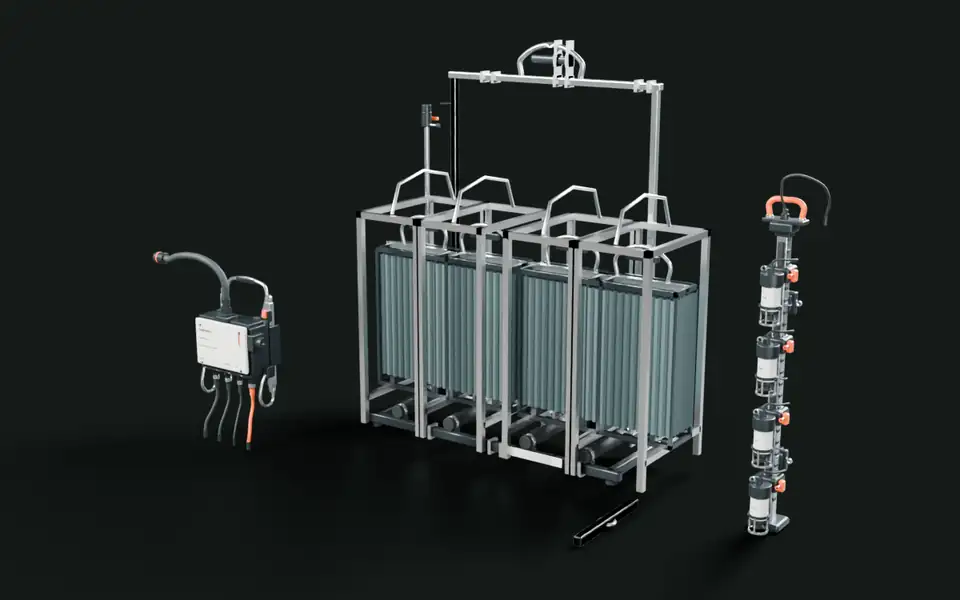
A wall station, a smart hub and six parts for the tank, each designed to lift out on its own.
Part by part
02 · All the way around
A smart hub and six in-tank parts. The Control & Air Station stays on the house wall.


03 · Pulled apart
In-Tank Smart Hub lifts out. Media & Aeration Unit modules lift out by their lift frame.

04 · In your tank
Compartment 1 settles. Compartment 2 treats, polishes and pumps. One buried line connects the wall station.

05 · Service from above
The compartment-2 lid comes off; modules lift through the 24-inch port.

06 · Control & Air Station
Controls and air supply stay outside on the house wall.
What's in the system
Choose a part. See where it sits, how it comes out and what remains untested.Note 1
A slim wall station with the controls and the air supply. One combined power, data and air line runs to the tank.
Where it goes
The existing tank stays. Everything goes inside it, through its two standard 24-inch access ports.

Control & Air Station
Sensor Spine · Replaceable Sensor Pod
In-Tank Smart Hub · Media & Aeration Unit · Top-Discharge Pump · Vertical Gravity UV · Non-Float Level Sensors
Development preview. Host-tank compatibility, treatment capacity, approvals and service intervals are not yet released. Planning boundaries
A qualified host-tank and adapter range—not a promise that one size fits every installation.
Design goals: plain-language status, reasons for service and a clear cost before work.
Individually retrievable modules, identified components and useful records for the next professional.
A property service record is a feature in development, not something available today.
Planning questions for a qualified professional. Subfield remains in development.
| Review | Subfield retrofit | Full replacement |
|---|---|---|
| Tank | Suitable tank retained after review. | Review need for replacement. |
| Digging | Review existing access ports and site work. | Review excavation and replacement layout. |
| Treatment | Qualify the complete retrofit configuration. | Select a system that meets the site requirements. |
| Knowing what is due | Status and service records: design goals. | Ask how inspections and service are recorded. |
| When you sell | Property record: a feature in development. | Gather permits, inspections and service history. |
01 / Product information
A development preview, not a released configuration.
A coordinated retrofit platform for an existing tank. Qualification begins with the existing tank’s condition, geometry, usable volumes, access and approved downstream system. Treatment, mounting, circulation, clarification and protection must work as one reviewed configuration.
The Subfield retrofit enhanced treatment system is sold directly by Subfield. There is no online store or checkout yet: send an order request and the Subfield team handles the order from there, starting with whether your existing tank qualifies.
Subfield is an engineering-development program. There is no released structural rating, electrical specification, final pump selection, independently verified treatment performance or maintenance interval yet.
02 / Compatibility
Tank, access and disposal are reviewed together.
Review tank integrity, usable volumes, baffles, access, ventilation and the approved disposal system together. Nominal tank gallons do not establish treatment capacity.
Record actual condition, geometry, working volumes and access.
Missing critical information means further review—not assumed compatibility.
A damaged, undersized or inaccessible tank may not qualify. The tank, in-tank equipment and disposal arrangement require configuration-specific review.
Confirm against the released documentation and approved installation record before use.
Confirm against the released documentation and approved installation record before use.
Confirm against the released documentation and approved installation record before use.
An order request does not establish compatibility.
Understand eligibility03 / Service approach
Service starts with the installed record.
Plan professional access, normal pumping, required inspections and component-specific care from the beginning. A three-to-five-year hardware-service goal is not a published care schedule or permission to omit required visits.
Preserve ordinary pumping, required inspection and independent removal paths in the actual host tank.
Retain host measurements, approved configuration, installed revisions, commissioning and service contacts.
Use the released configuration-specific schedule. Pumping, mandated visits and purchased-pump obligations remain separate from hardware-life goals.
04 / Ownership
Design goals: plain status, service context and a record that stays with the property.
Plain-language status, so an ordinary day needs no attention and a problem is explained instead of guessed at.
Service planned from the system’s own record and condition, with the reason explained.
A clear description of the work and what it will cost before the work is done.
A service and ownership record that stays with the property when it changes hands: its configuration, service, repairs and component changes. This is a feature in development, not something available today.
Subfield is not designing a maintenance-free system. The design goal is maintenance without surprise: you know how the system is doing, what service is due and why, and what work will cost before it is done, with fewer surprise visits.
Subfield is an engineering-development program. There is no released structural rating, electrical specification, final pump selection, independently verified treatment performance or maintenance interval yet.
These are design goals, not promises. Pumping, required inspections, wear parts and purchased-pump care still matter, and no maintenance interval has been established. Subfield’s planned launch focus is Santa Cruz County, California. That is a plan, not a county approval: the system has no county approval, and none is installed there.
05 / Before you order
Open what matters now.
No. The objective is broad coverage through a qualified range of host tanks and adapters. Condition, geometry, access, usable treatment and solids-storage volume, ventilation and the downstream field must all be reviewed.
Not yet. Approximately 600 US gallons per day is an initial development duty. A rating requires testing of the complete configuration at defined wastewater loads and operating conditions.
No. The goal is maintenance without surprise, not maintenance-free: knowing how the system is doing, what service is due and why, and what work will cost before it is done, with fewer surprise visits. These are design goals, not promises. Pumping, required inspections, wear components and purchased-pump care remain; a three-to-five-year interval is not established.
Anyone can buy the Subfield retrofit enhanced treatment system, but we strongly prefer that it be installed by a licensed septic or onsite wastewater professional. Local codes and permit requirements apply; check with your local health department or permitting authority before installing.
Not yet. Subfield is an engineering-development program. There is no released structural rating, electrical specification, final pump selection, independently verified treatment performance or maintenance interval yet.