The retrofit / How it works
Give the biology
a better place to work.
The proposed process uses oxygen, attached microorganisms and deliberate solids separation.
Development preview. Host-tank compatibility, treatment capacity, approvals and service intervals are not yet released. Evidence before promises
The treatment path
Five jobs.
One defined treatment path.
The existing tank stays. Everything goes inside it, through its two standard 24-inch access ports.
- 01
Preserve primary settling
Details: Preserve primary settling
Keep the existing tank’s quiet receiving area and space for accumulated solids. The retrofit must not compromise normal pump-out access or required storage.
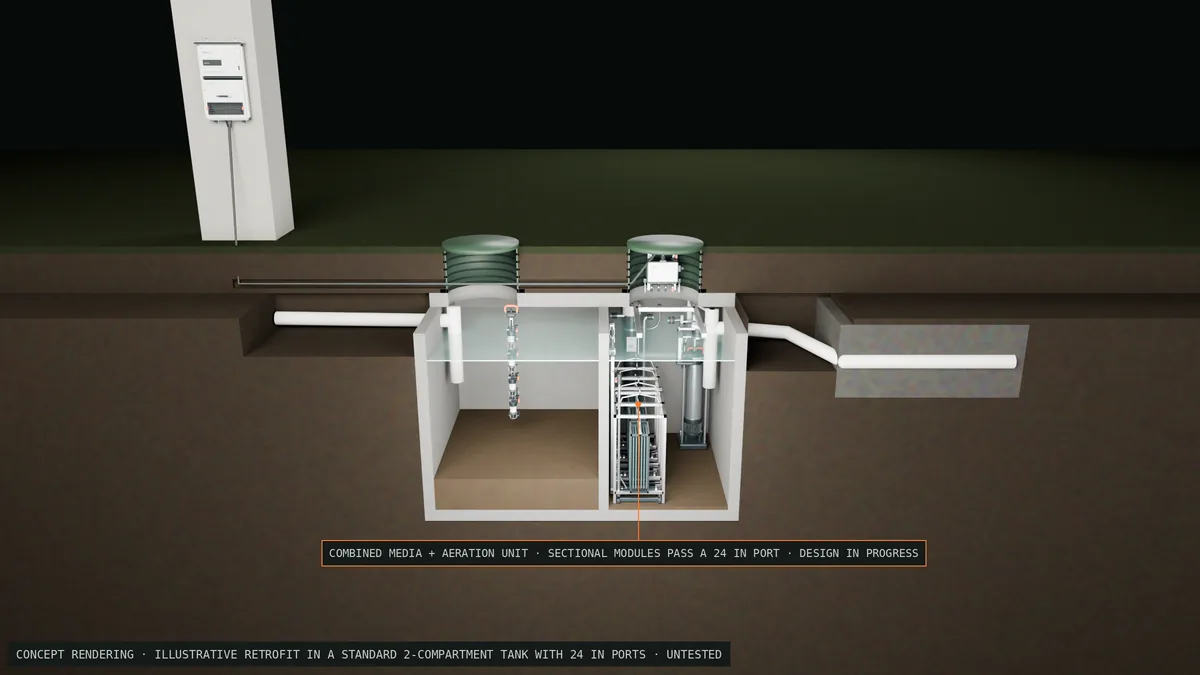
Concept rendering · not a released design · untestedInstalled views show an illustrative standard two-compartment concrete tank with two 24-inch access ports. Every in-tank part is shown going in and out through those ports; the combined media and aeration unit is shown as sectional modules, a design still in progress. They are not your tank and do not show that the system fits any particular tank. - 02
Bring biology and air together
Details: Bring biology and air together
Microorganisms grow on removable fixed-film media. A defined air supply and airlift circulation bring oxygen and wastewater to the treatment surfaces.
It is not simply a finer filter.
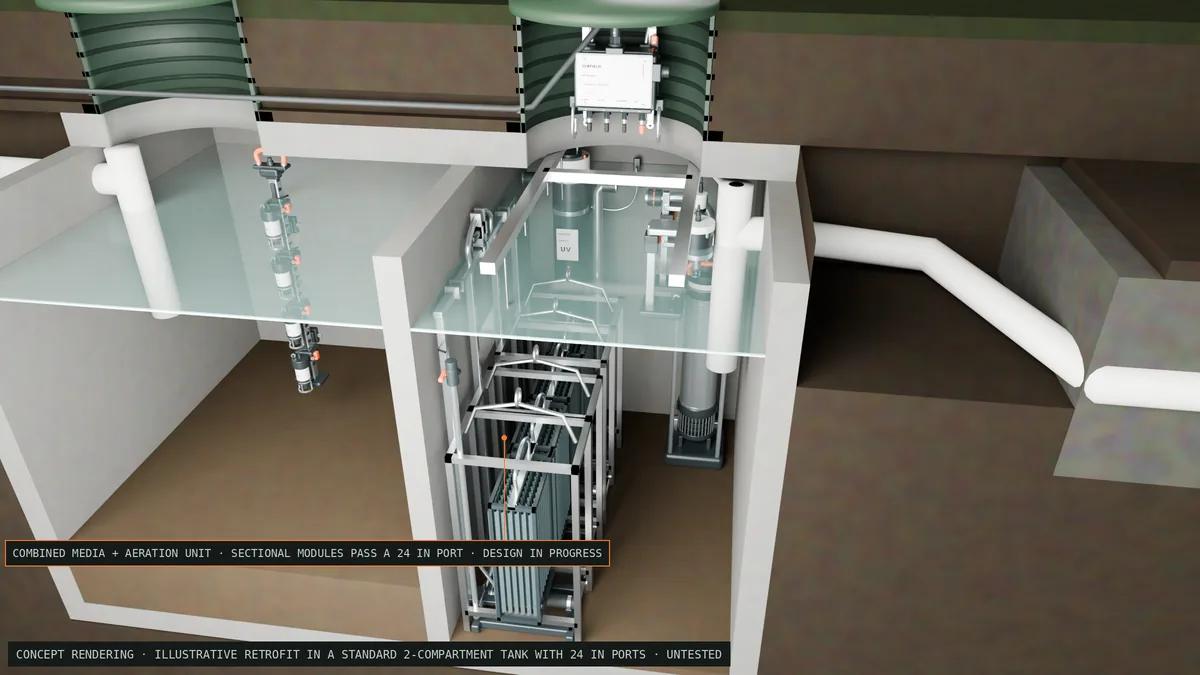
Concept rendering · not a released design · untestedInstalled views show an illustrative standard two-compartment concrete tank with two 24-inch access ports. Every in-tank part is shown going in and out through those ports; the combined media and aeration unit is shown as sectional modules, a design still in progress. They are not your tank and do not show that the system fits any particular tank. - 03
Protect the outlet
Details: Protect the outlet
A deliberately separated clarification area retains material released by the biological stage. More aeration must not mean more solids reaching the field.
- 04
Check the actual result
Details: Check the actual result
Accessible sampling and configuration-specific testing establish effluent performance. Equipment status or clear-looking water is not a substitute for laboratory evidence.
- 05
Respect the existing site design
Details: Respect the existing site design
The outlet connects to the approved gravity or dosing arrangement. Required field filtration, nitrogen treatment or disinfection are separately qualified options—not automatic capabilities.


What powers the process
Air where it helps.
Quiet where it matters.
What powers the process
A dedicated submerged manifold supplies air near the media. The airlift is intended to circulate wastewater through defined passages while the primary compartment and outlet clarification remain protected from unnecessary disturbance.
The tank remains vented; it is not a pressure vessel. Air demand, circulation, solids retention and energy use must be measured together before the configuration is rated.
Development boundaryNote 1
Evidence before promises
Test the whole system.
Not just a sample.
Evidence before promises
Development must verify sustained organic and suspended-solids removal at actual loads, including surges, cold conditions, low-use periods and restart. Equipment diagnostics help service the system; laboratory evidence establishes the water-quality result.
Nitrogen, phosphorus, disinfection and reuse require their own defined treatment pathways and validation. No universal nutrient or pathogen-removal claim is made.
DisinfectionNote 2
See the engineering boundariesDevelopment boundaries
- Power loss, air loss and restricted outlets require a reviewed failure response. Controls cannot create unlimited storage or make off-spec discharge compliant. ↩︎
- Disinfection is a separate requirement. UV is a conditional research module, not an automatic feature of the base retrofit. The complete reactor, actual effluent quality, flow and service requirements need separate validation. Explore UV disinfection research; these source studies are not released installation instructions or evidence of safe reuse. ↩︎
Before you begin
A clear starting point.
Understand the product direction, its limits and what must be proven before an installation.
Does it fit every septic tank?
No. The objective is broad coverage through a qualified range of host tanks and adapters. Condition, geometry, access, usable treatment and solids-storage volume, ventilation and the downstream field must all be reviewed.
Is this just a filter?
No. The proposed core is an aerobic biological process supported by fixed media, with controlled circulation and protected solids separation. Required coarse protection or field filtration performs a different job.
Is it rated for 600 gallons a day?
Not yet. Approximately 600 US gallons per day is an initial development duty. A rating requires testing of the complete configuration at defined wastewater loads and operating conditions.
Will it be maintenance-free?
No. The goal is maintenance without surprise, not maintenance-free: knowing how the system is doing, what service is due and why, and what work will cost before it is done, with fewer surprise visits. These are design goals, not promises. Pumping, required inspections, wear components and purchased-pump care remain; a three-to-five-year interval is not established.
Do you manufacture the pumps?
No. Pumps are the explicit purchased exception to our original-assembly manufacturing plan. The air-pump or blower production arrangement remains under evaluation.
Start with the installation you have
One system.
A clearer way forward.
Project brief
Bring the records and questions you already have. A project brief starts the conversation; it does not approve a tank or reserve equipment.