Engineering records / Engineering record / BASE-TRAYS-R1
Base Trays R1.
Geometry, analysis and remaining engineering work for Base Trays R1.
Retained development study. Dimensions, names and checks belong to this revision—not automatically to the retrofit-only product. Manufactured tank shells are deferred. No installation instruction, certification or manufacturing release is represented.
The source reasoning
Why this detail was investigated.
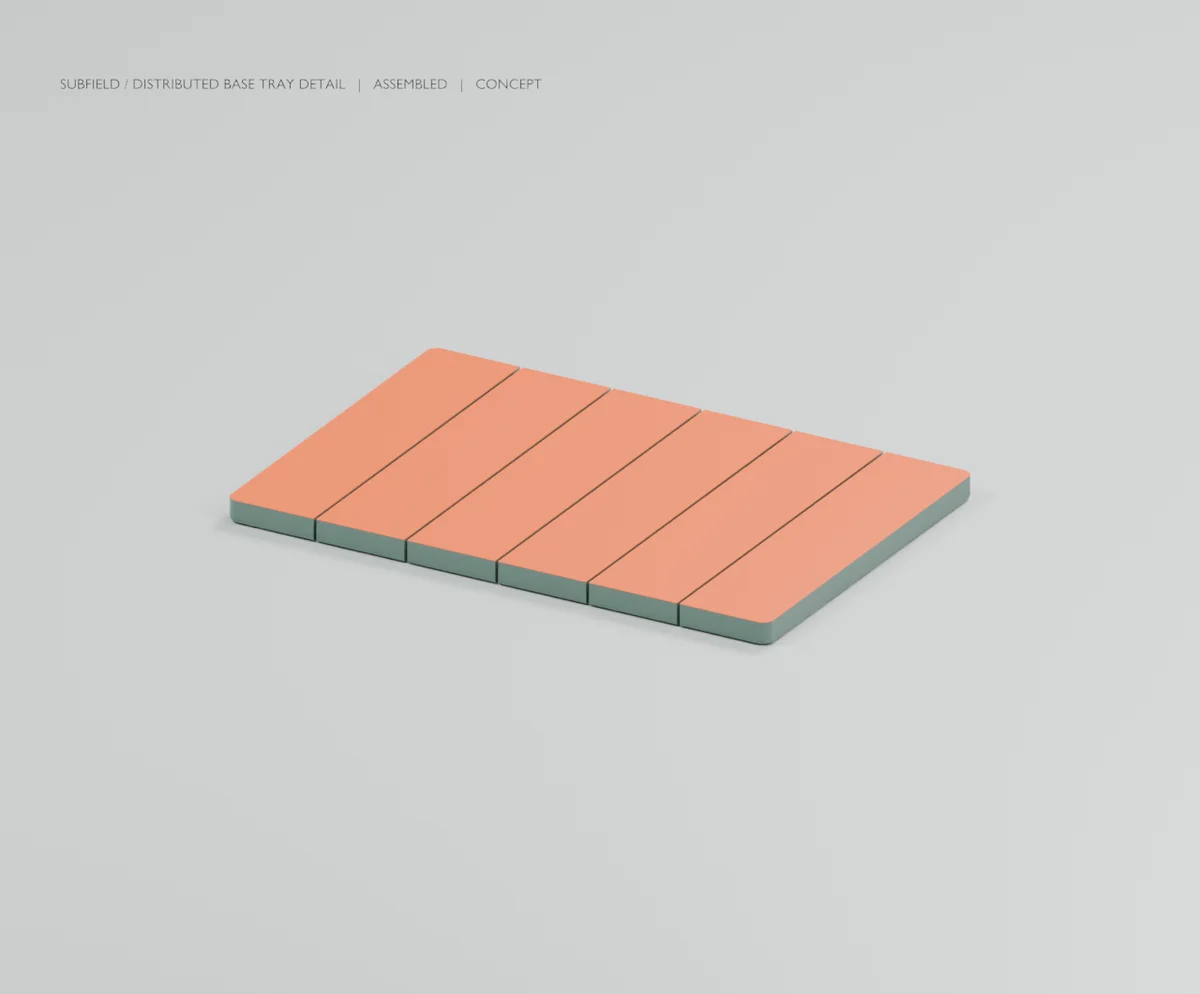
Six separate ribbed trays and covers replace the old six base crossmembers and 18 small shoes in this alternative. The posts retain their existing height and contacts. The complete alternative assembly contains 73 solids; the detail render separates the covers to show the internal webs.
Read the research and limits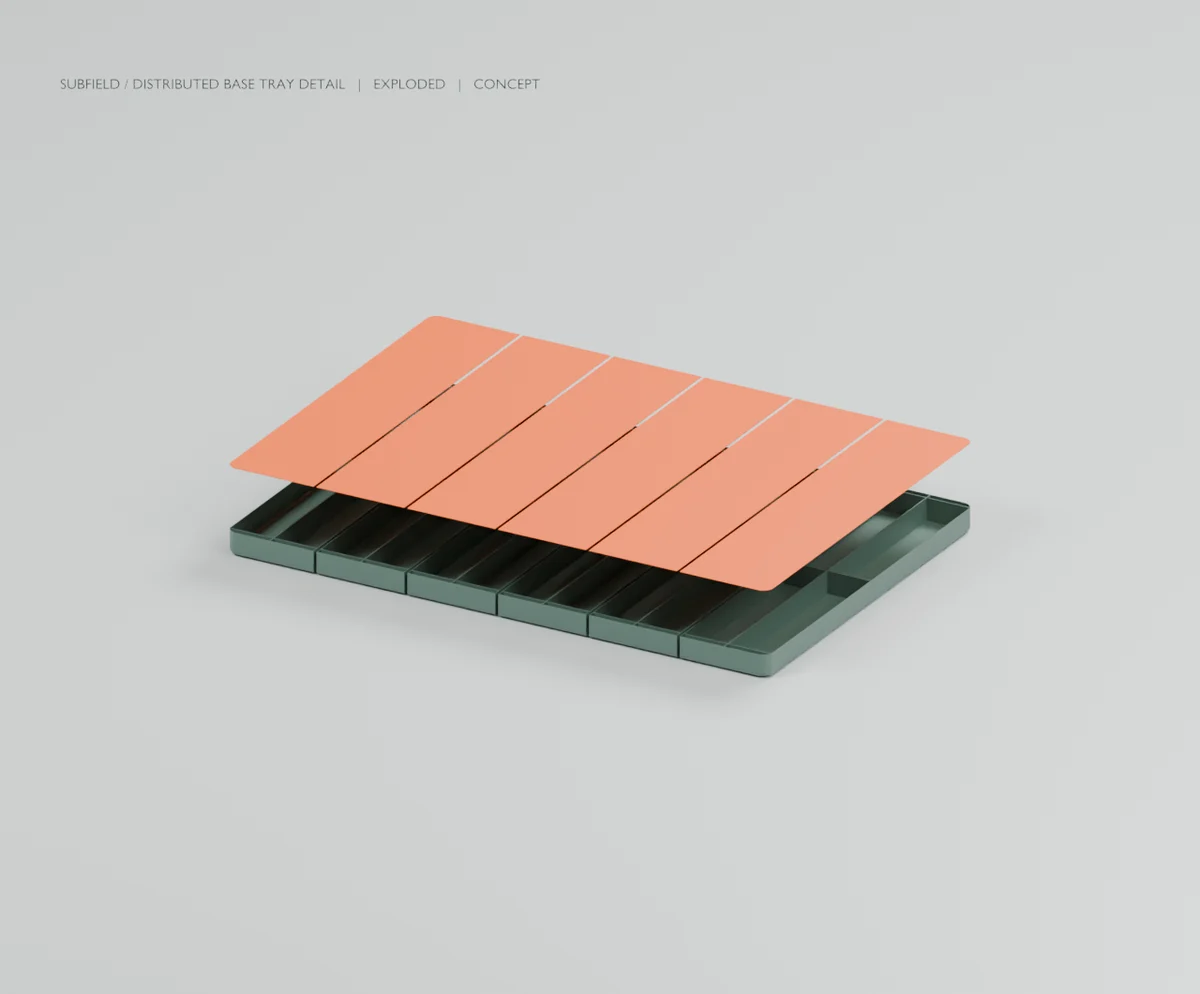
Research record
The detail behind
the study.
Source-linked work for this revision. Reported checks describe the stated model or test; physical qualification and applicability to the current retrofit remain separate.
Distributed-base comparison — not selected
Six separate ribbed trays and covers replace the old six base crossmembers and 18 small shoes in this alternative. The posts retain their existing height and contacts. The complete alternative assembly contains 73 solids; the detail render separates the covers to show the internal webs.
The geometry fits, but its 100.93 kg assumed mass replaces only 29.43 kg of the prior base. This approximately 71.49 kg penalty is not compatible with treating the historical lightweight budget as achieved. The candidate is retained as comparison evidence, not selected as the production base.
If its cavities are sealed, the modeled external envelopes displace approximately 215.07 US gallons. The actual sealing/flooding strategy remains unresolved. Neither the nominal projected area nor broad contact establishes uniform pressure, floor strength or soil performance.
Initial dimensions are 500 mm tray width, 17 mm gaps, 3 mm floor/walls/covers and 6 mm webs. These are not strength-optimized laminates. Cover bondlines, local reinforcement, fillets, ply transitions, process tolerances and material qualification are absent.
Further development must reduce structural mass while solving tray/skin/bedding compatibility and local load transfer. Simply thinning the faces or webs is not an approved solution. The full STEP and check record allow this alternative to be compared without silently replacing the earlier model.
Source and revision record
Source: base-trays-r1/READ-ME.md
Source SHA-256: b92e672f72756196c26c31eb825ad6c2929d4c21c247f16826f5a45cee18864a
Geometry and images describe this development revision. Current product ratings and manufacturing release require separate qualification.
Return to the current product.
Explore the retrofit-only platform and its compatibility, installation and service objectives.
Explore the retrofit