Tank & access / Design study / BODY-HANDLING-R1
Support, considered.
Original underside saddles studied against the permanent tank frame.
Retained development study. Dimensions, names and checks belong to this revision—not automatically to the retrofit-only product. Manufactured tank shells are deferred. No installation instruction, certification or manufacturing release is represented.
The source reasoning
Why this detail was investigated.
The load path into the body needs deliberate bearing and bond interfaces. Clearance studies do not select rigging or establish a lifting rating.
Read the research and limits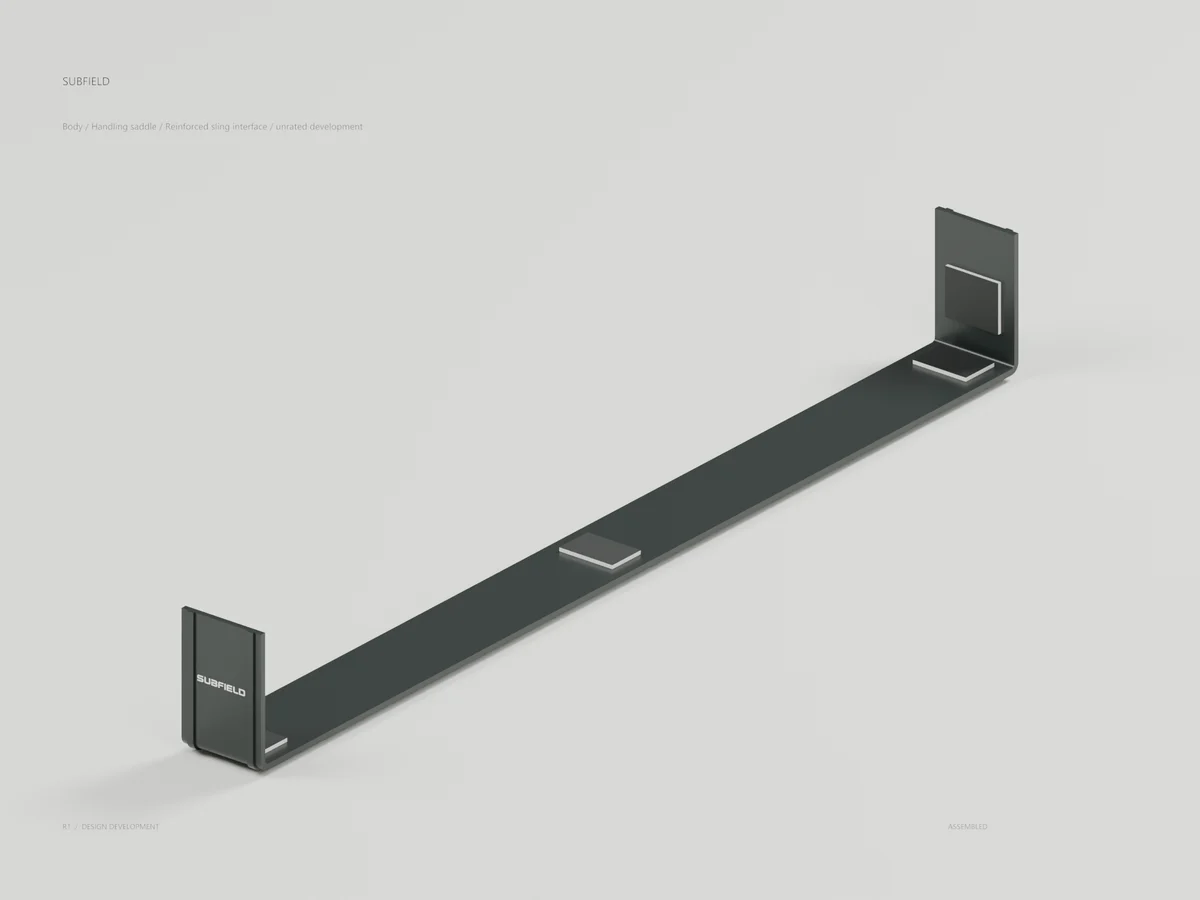
Research record
The detail behind
the study.
Source-linked work for this revision. Reported checks describe the stated model or test; physical qualification and applicability to the current retrofit remain separate.
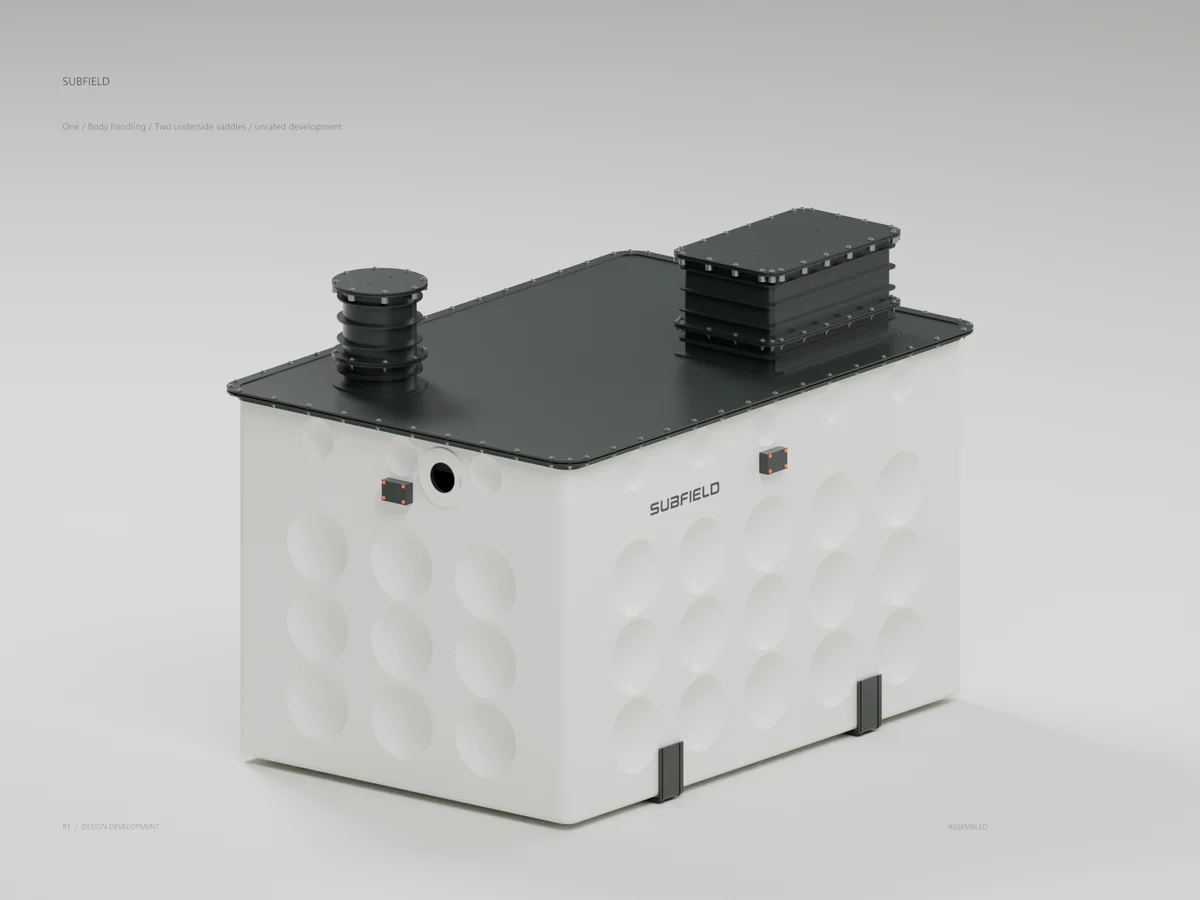
Original Subfield body-handling saddles, modeled against the permanent tank frame.
32 new solids. 173 CAD tests passed. No selected rigging, lifting rating or manufacturing release.
Tank / original underside saddles
Saddle / separate bearing and bond parts
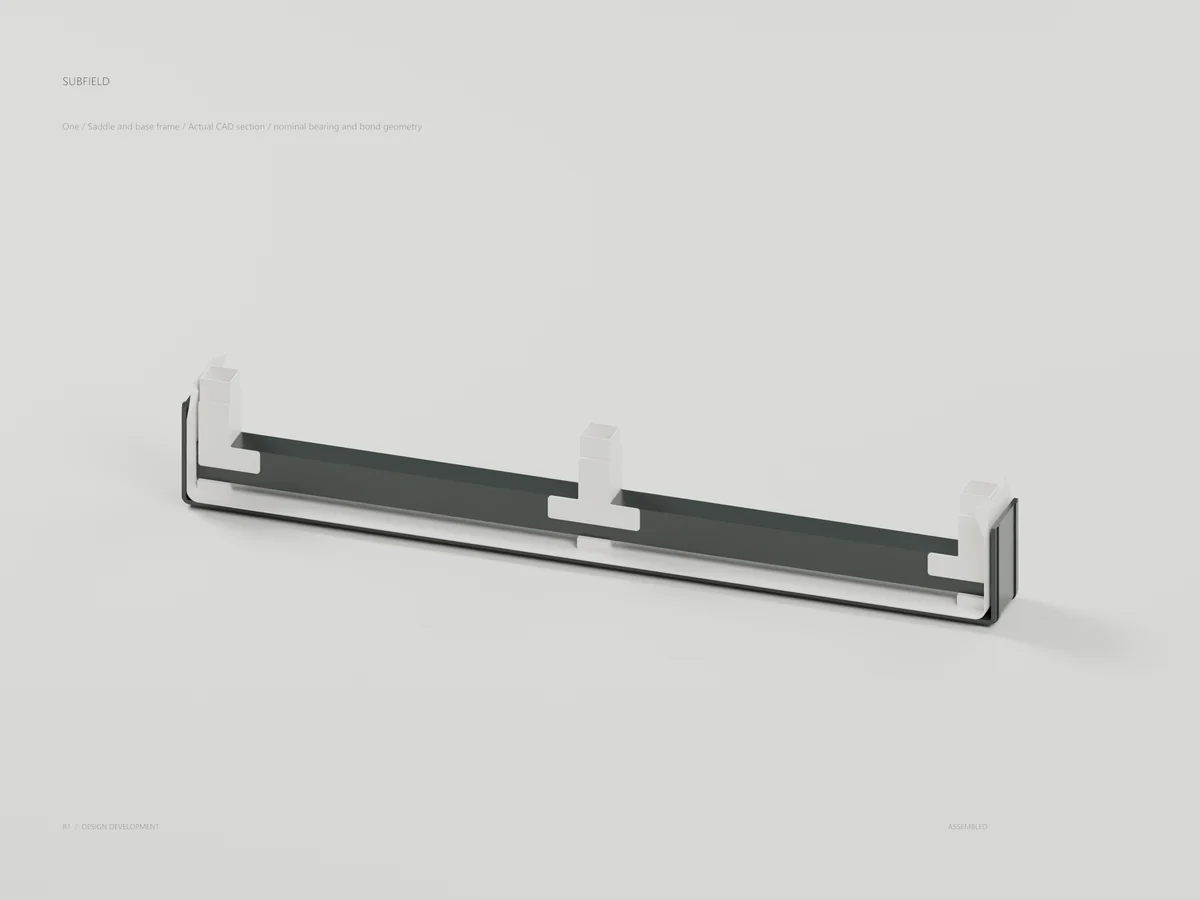
Frame / actual CAD section
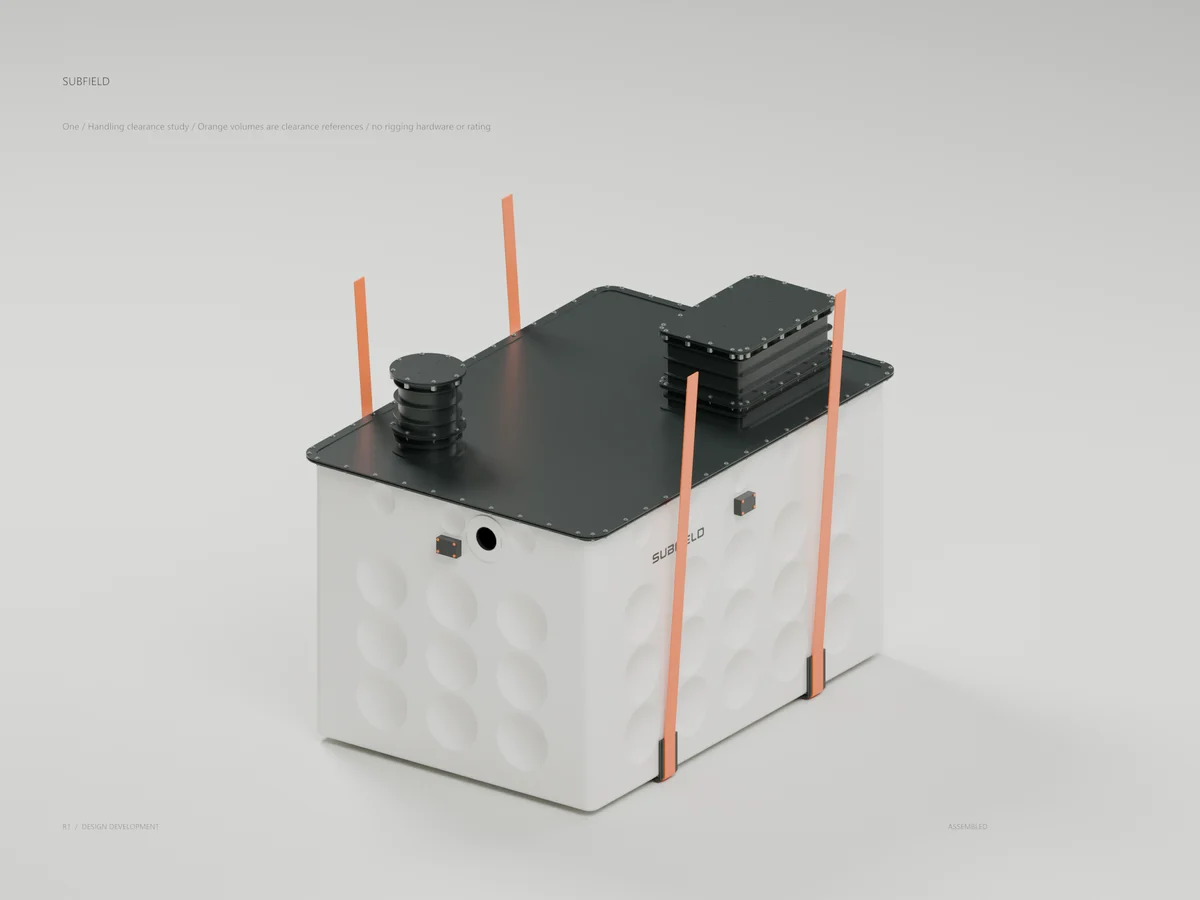
Handling / clearance references only
CONCEPT / UNRATED development package for SC-013. Two original continuous underside saddles align with permanent base crossmembers 2 and 5 at X -775.5 and +775.5 mm. Each has one saddle with integral guides, three lower bearing pads, two lower side pads and ten nominal bond volumes. Thirty-two original solids are added to the unchanged 2,633-body source tank, producing a separate 2,665-body candidate.
All 173 CAD tests, 34 unit checks and 31 whole-tank fit/export checks passed. Added solids clear the actual tank; nominal body bonds touch its skin; all six lower pad footprints align with existing internal shoes. Eight existing side-level extraction corridors remain clear. STEP transport checks preserve every original supplier body. These checks establish geometry only, not load capacity.
The orange reference volumes reserve space for an engineered spread arrangement. They are NOT slings, protectors, hooks or a spreader and are excluded from the product STEP. Separate reference STEP files carry a reference suffix. Four inward-directed reference legs intersect the tank; the rejected case is recorded in tank-fit/fit-record.json. No WLL, proof-load instruction or lifting authorization is provided. Whole-body handling and roof-only handling remain distinct; no roof-only points are introduced.
The model uses 12 mm saddle thickness, 7.5 mm bearing pads and two 0.5 mm bond layers at each interface. Guide channel width is 120 mm; guides project 24.5 mm beneath the original floor. These are preliminary allocations, not qualified material, sling or tolerance specifications. Assumed added mass for both saddles is 20.201 kg, based on 1,560 kg/m3 composite and 1,200 kg/m3 bond density. The existing 500 lb tank mass goal remains unmet.
The full coupled load path through saddle, pads, bonds, skin, inner shoes, permanent base members and joints requires strength/stiffness, local bearing, slip, creep, impact/damage and durability assessment. Complete mass, center of gravity, retained contents, tilt, load sharing and dynamic loads remain unresolved. Select and qualify actual rigging and edge protection together. Bedding support, ground clearance and sling removal also remain open. Laminate, adhesive, fiber orientation, tooling/draft, process, preparation/cure, inspection and production tolerances are not released.
The 150-scope ledger records 51 partially modeled concepts, 63 not modeled, 31 deferred and 5 non-geometric. No scope becomes ready for release from these images or geometry checks. Complete manufacturing design remains in progress.
Source and revision record
Source: body-handling-r1/index.html
Source SHA-256: f90f6a9e209133f25f638125453af161d5ad043769db6f4067017b1081c8d4a4
Geometry and images describe this development revision. Current product ratings and manufacturing release require separate qualification.
Keep exploring the research.
Tank & access / Design study
Standard tank partitions
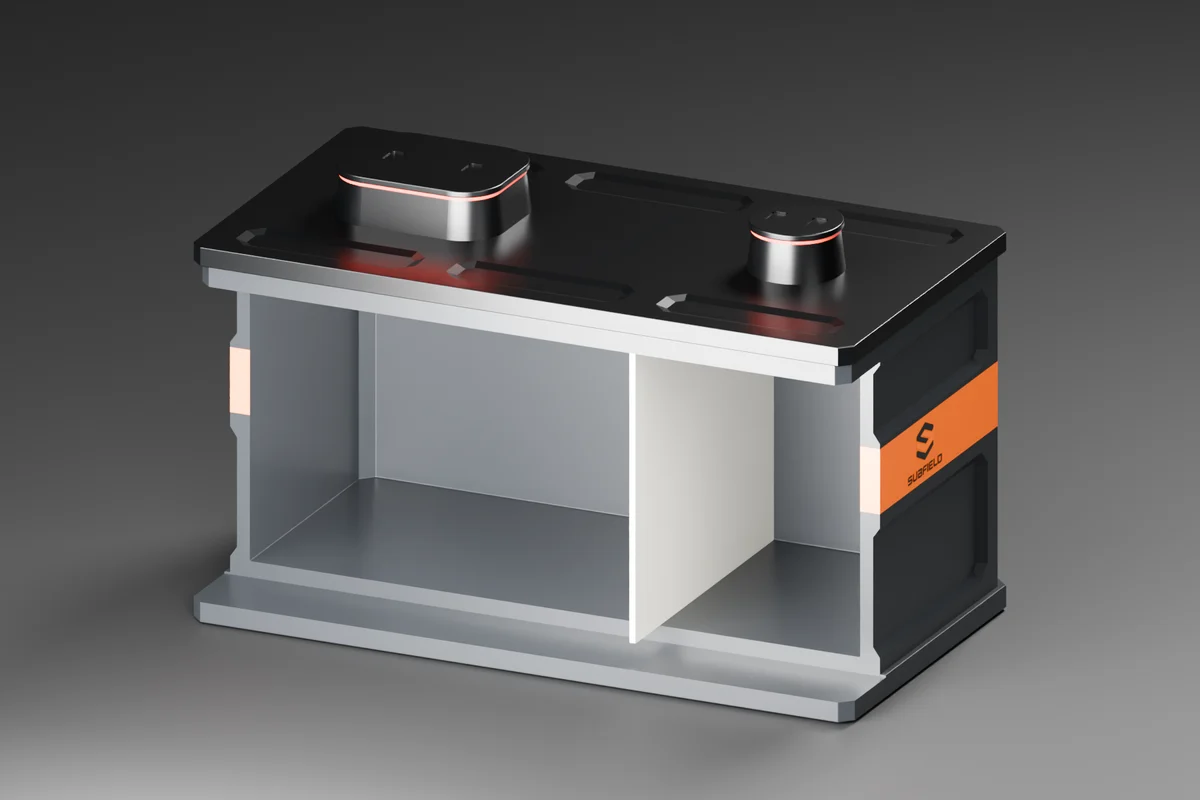
Layered partition fit studies for SUB1500 and SUB2000.
Tank & access / Design study
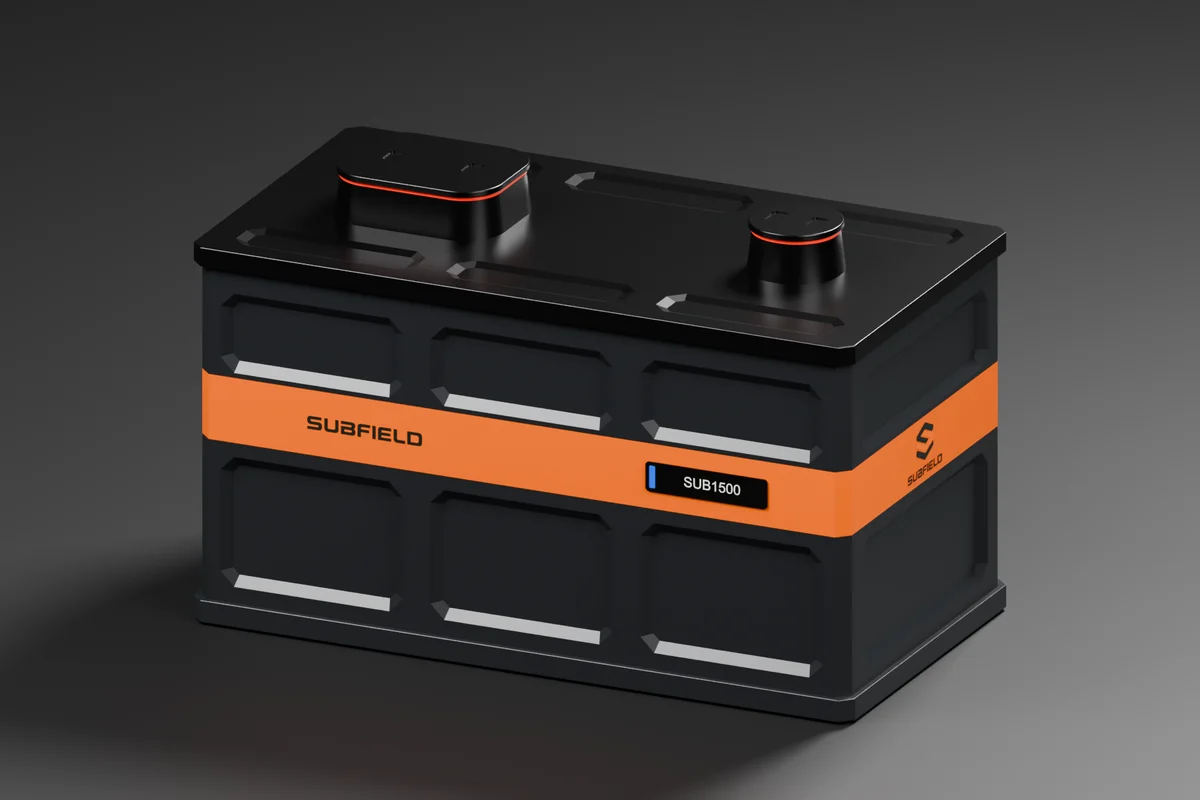
Two-size tank family
Four planned models, with separate 1,500- and 2,000-gallon body envelopes.
Tank & access / Calculated study
Tank capacity study
An empty-cavity calculation examines headspace and displacement reserves.
Return to the current product.
Explore the retrofit-only platform and its compatibility, installation and service objectives.
Explore the retrofit